 www.socalnaturist.org |
|
The Movie BuffTM:
|
|
Name of Film:
Inside Deep Throat
Our Rating:
Documentary, MPAA Rating: NC-17 for (about 15 seconds of) explicit sexual content
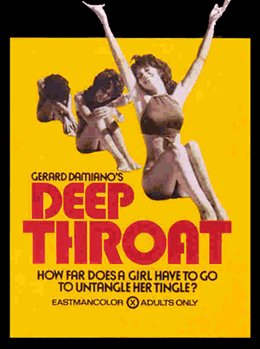
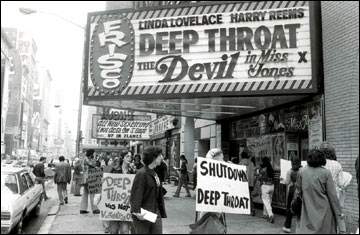
While it may seem incongruous to be reviewing a film about a porno movie in a naturist publication, it is important to remember Deep Throat in its cultural context of the early 1970’s. The first amendment battles waged back and forth over this movie directly affected the ability of the free beach movement to gain a foothold; later, those same courthouse victories helped legitimize the widespread distribution and acceptance of naturist publications through the mail.
"Inside Deep Throat," a documentary that premiered at Sundance and is now going into national release, was made not on the fringes but by the very establishment itself. The producer is Brian Grazer ("A Beautiful Mind," "How the Grinch Stole Christmas") and the directors are Fenton Bailey and Randy Barbato ("Party Monster," "The Eyes of Tammy Faye"). In short, this is a fascinating documentary that deftly chronicles the cultural phenomenon that was the 1972 X-rated movie. The documentary has an NC-17 rating, mostly due to about 15 seconds of hard-core footage that is included from the original film.
The movie uses new and old interviews and newsreel footage to remember a time when porn was brand-new and, with a sense of ironic humor, it remembers a political climate in which governmental commissions and officials, along with self-appointed moralists, unsuccessfully tried to push their own social code into American culture.
To its credit, the documentary treats the principals on both sides of the conflict with respect. Inside Deep Throat weighs in with “talking head” opinions from Norman Mailer, Gore Vidal, Erica Jong, Camille Paglia, Helen Gurley Brown and Dr. Ruth Westheimer. But just so it doesn’t take itself too seriously, it also includes an interview with a colorful retired Florida exhibitor who laments his misgivings about screening the movie and whose wife provides a riotously funny running commentary on everything he says. There are also interviews with Deep Throat’s director, Gerard Damiano, with the film’s principal actors Linda Lovelace and Harry Reems, and with prosecutor Larry Parrish (who tried unsuccessfully to discredit the film and Reems by having him arrested on solicitation of murder charges).
Also on the “anti-movie” side are the documented the actions of President Richard Nixon before his impeachment; Roy Cohn before his disbarment; and Ohio's famed anti-smut crusader Charles Keating (chairman of “Citizens for Decent Literature”) before his Lincoln Savings and Loan scam put him behind bars for four years.
To give an historical perspective on how Deep Throat changed American culture, the documentary goes back to 1960 when independent filmmaker Russ Meyer produced "The Immoral Mr. Teas," the first commercially successful film featuring nudity (but no visible genitalia.) Its appeal was primarily men, whom film critic Roger Ebert called “the raincoat brigade.” Local prosecutors attempted to prevent Meyer from showing his film, mostly at shabby little theaters on the wrong side of town. The case went to the U.S. Supreme Court, whose ruling seemed to permit the hard-core stuff. Deep Throat was the first film to use the ruling and take explicit sexual content to a mass audience.
Gerard Damiano, was a successful hairdresser before he decided to make Deep Throat using $25,000 of his own money. Listening to his clients talk about sex, Damiano said he realized that pornography had crossover appeal. All you had to do was position the advertising in such a way that couples would come.
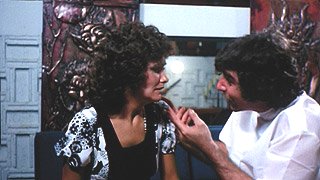
In reality, the movie was not very good (even its director says that) but it was explicit in a way that was acceptable to its audiences, and it leavened the sex with humor. Not very funny humor, to be sure, but it worked in the giddy, forbidden atmosphere of a mixed-gender porn theater.
Now respectable middle class couples and even celebrities were seen lined up for "Deep Throat" and talked cheerfully to news cameras about wanting to see it because, well, everybody else seemed to be going. Filmmaker John Waters notes that Deep Throat didn't incite in-theater masturbation when it caught on with the masses. After all, he says, you might be sitting next to Angela Lansbury. In 1972, Roger Ebert wrote in his original review: "The movie became 'pornographic chic' in New York before it was busted. Mike Nichols told Truman Capote he shouldn't miss it, and then the word just sort of got around: This is the first stag film to see with a date."
“It was a giggle,” says author Norman Mailer, hitting the right note of jauntiness. “It was all about the rebellion,” says onetime porn star Andrea True, hitting the right note of period-counterculture defiance. Bob Woodward and Carl Bernstein co-opted its title for their anonymous Watergate source, and Bob Hope and Johnny Carson alluded to it in their monologues.
The success of Deep Throat inspired a national censorship battle. While everyone remembers the report of a presidential commission that found pornography to be harmful, not many people remember that was the second commission to report on the subject, not the first. The 1970 commission (published before Deep Throat was filmed), headed by former Illinois Gov. Otto Kerner, found that pornography was not particularly linked to antisocial behavior, and that indeed sex criminals as a group tended to have less exposure to pornography than non-sex criminals. This report, based on scientific research and findings, was deemed unacceptable by the Reagan White House, which created a 1986 commission headed by Attorney Gen. Edwin Meese, which did no research, relied on anecdotal testimony from the witnesses it called, and found pornography harmful.
This documentary has Damiano complaining that most of the profits went to people he prudently refused to name as “the mob,” but we know whom he means. Deep Throat is estimated to have grossed between $200 million and $600 million, making it the most profitable X-rated movie of all time but since the mob owned most of the porn theaters in the pre-video days and inflated box office receipts were a way of laundering income from drugs and prostitution, it is likely the true figures may never be known.
Other high-budget movie productions followed, such as The Devil in Miss Jones and Behind the Green Door. There were predictions that explicit sex would migrate into mainstream films but the studios soon found out that the “X” rating was a kiss of death for profits, if just because many large metropolitan newspapers refused to carry advertising for movies that carried that mark of shame.
By 1974 the boomlet was pretty much over, and the genre went back to the sleazy porno movie houses. It would take another decade until the advent of video tape, DVD, and cable television fostered a new boom in the genre, as couples began watching in higher-quality porn (that term is used advisedly here) in the comfort and safety or their own homes.
The documentary ends with a “where are they now” segment, which reveals some interesting facts:
|


Review by Gary Mussell, SCNA Film Critic
Email Us Your Comments About This Review
READER COMMENTS...
Reader Replies to Inside Deep Throat Review
DEAR SCNA:
I read your write up on Deep Throat and Linda Lovelace, and had to write to you. I've been following the "LL" saga since I saw her on a late night talk show, and am afraid that the movie Inside Deep Throat did Linda a disservice.
Deep Throat is said to have grossed $600 million, but that is really the FBI's number and includes box office gross and merchandise receipts. It was recently estimated that the film grossed more than $1 billion when adjusted for inflation, making it the most profitable film ever. We'll never know, as profits may have been inflated to cover the mob's other income streams.
Linda's claims that Chuck beat her were sidestepped during "Inside," and the filmmakers are to blame. Two people back up her story of being beaten during Deep Throat's filming on the DVD's 2nd audio track -- one guy was sleeping in the room next to hers, as did Andrea True, LL's costar in Deep Throat 2, who says Chuck was a sexual sadist.
The filmmakers of Inside Deep Throat did Linda a disservice by having Gerald Damiano say no one held a gun to her head. What he did not say was what was published in the book "The Other Hollywood" that Chuck beat Linda ferociously, and that she was rarely out of his sight. This dovetails with much of her talk in Ordeal and Out of Bondage. This also coincides with what she described as Chuck's "training" her to say about sex (she loved it, etc.), esp'ly when Marilyn Chambers came around and starred in films similar to the ones Linda so feared (Never a Tender Moment, Beyond DeSade). Chambers was also rarely out of Chuck's sight, and in her interview with Vanity Fair magazine (1987? - 1990? she's on the cover), Chuck himself says he beat his woman if she said something he didn't like. There were several instances where Linda's talk of Chuck's treatment of her (refusing to let her go to the bathroom, for instance) were verified by others (Gloria Steinem, just before appearing on a talk show). Eric Danville, a writer for Screw, and later author of The Complete Linda Lovelace, said Linda cried when he showed her pictures of the 8 mm doggie loop, and begged him not to include those photos in his book. Danville said it was more likely a domestic abuse situation and not typical of the porn industry as to how Linda was treated, and he concluded that Linda was not in any of the porn movies willingly -- and that Chuck was behind it all. This is also said in The Other Hollywood.
Joe Bob Briggs, a conservative writer for the UPI newswire, wrote a very misleading article on Linda after her death, and most of his facts were just wrong. To my knowledge they were never corrected, which hurts UPI and JBB's credibility. You should not let that happen to your Website!
I've read where some people said Linda was by herself and not with Chuck now and then, and the only explanation seemed to be that she was scared to death of him -- of crossing him, of being beaten or sexually tortured, etc. These tortures were detailed in both her books, and she does have black and blue marks on her body in the film. The other books she wrote under the name Linda Lovelace sound too good to be true, don't you think? Especially the explanation of her bruises in "Inside Linda Lovelace."
While I liked "Inside Deep Throat," the DVD and the film aren't exhaustive in their research. There's a small clip where they filmed in Binghamton, NY, where Deep Throat was not banned in New York state (I know, because that's where I grew up), but this is not explained. They interviewed the owner of the now defunct Art Cinema, where Deep Throat played in the 1980s -- this is never mentioned. Overall, I thought the movie wasn't very even handed, and really let Chuck off the hook for being a wife beater.
Deep Throat played at SUNY-Binghamton for years as a fall semester fund raiser, and the former Linda Lovelace spoke to the Women's Center there. The movie was eventually banned by the students as political correctness became the norm (1985 I think was the last showing).
Regards,
Glenn Allen
Morristown, NJ
May 08, 2006